Polish Londoner

These are the thoughts and moods of a born Londoner who is proud of his Polish roots.


Thursday, 4 May 2023

Packing begins


 Borealis Friday 5th May 2023

When I got up this morning I continued saving the remaining photos that Tony had given me. By 9am I had finished, and I pocketed the USB link to return it to Tony. I went for a pre-breakfast one mile walk around the ship (3 and a half laps around the ship on Deck 3). Others were doing the same, but there were no more groups of whale watchers perched with their binoculars on the bow of the vessel. I also passed the sad gentleman with Alzheimer's three times, as he stood there aimlessly staring out from the vessel's stern. 

After breakfast I attended a lecture on the geology of the Caribbean, under the mistaken impression that it was going to be one of two lectures on pirates in the Caribbean. Instead it described how the West Indies emerged from volcanic activity and left an archipelago of islands with beaches on one side and coves and hidden caverns on the other side which pirates were able to utilize. I then remembered to arrange for a wifi link for my phone which Albina uses for her Whats App telephone calls, in order to match the link I received yesterday for my laptop.  

As we were so concerned about the packing in time for our departure in 8 days' time, I pulled four of our six cases from under our bed for Albina to plan the packing. I should add that packing is one of her major contributions to our 50 year marriage. I left the room and she set to work. I lay in the sun by the pool, and afterwards attended a real lecture about the pirates in the Caribbean, all about Blackbeard and Morgan and Calico Joe, hanged with his two mistresses, after they had given birth to his children. When I got back to the cabin, she was in the last throes of packing the third case. She put away everything that she thought we would not need for the next week, which unfortunately included some of my more colourful shirts. The only trouble is that all three cases now weigh about 20kg apiece and are too big to squeeze under the bed. We will have to leave them stacked up in the corners of the roomfor the rest of the voyage. The fourth case went back under the bed again to await being packed another day. It was a really impressive achievement and it left Albina physically exhausted..  

After dinner, which Albina had in her cabin, I attended a show by a brash lady comedian called Jo Little, who mixes working class humour from her native Pontefract with coarse but passionate renditions of songs by Edith Piaf, Lulu and Dusty Springfield. We had a very poor showing at the General Knowledge Quiz ending with only 8 correct out of 15, although some of the questions about advertising slogans were indecipherable, due to the quizmaster's bizarre pronunciation. After that I promised to give moral support to Sharon in her entry for karaoke night in The Observatory. She had a brave bash at singing Super Trouper. After that it was time to retire as we were losing yet another hour tonight.

Latest news from elections in England and Wales: the Tories had lost more than 1000 Council seats. I wonder how long Johnson and Truss will continue to evade responsibility for this mess?

Roaring Twenties


 Borealis  Thursday 04.05.2023

The journey back continues and the anxieties return. I know that sufficiently from my dreams. Questions tormented me. Like what happens to our luggage at Southampton when it will no longer be Fred Olsen's responsibility? When we have to think for ourselves again and not leave it all to the ship's staff to organize. I must admit I don't know how to contact Rol Cruise through whom we booked the holiday, because we organized the port to door chauffer with them. They have a phone line, but not on Whats App and they indicate no email, so I have no means of contacting them. That is my next anxious worry. 

Just after lunch I listened to a lecture on the Atlantic Crossing, about how the conditions of passengers on ships changed over the centuries. It is interesting to know how current luxuries such as individual bathrooms with each cabin developed only after the First World War, or that third class passengers on the big liners had no access to the outside decks.

As my wifi link, which I purchased at the beginning of the cruise, had expired after 70 days, I purchased a new one with Guest Services for £63 to last me another 10 days. For the last two days of the cruise I will again be without a link, which may be awkward. 

In the meantime, I had arranged with Tony to release some photos to me covering the cruise from Hawaii to St Kitts. In the end Tony gave me a USB link to transfer a total of 168 photos covering everything from Lisbon to St Kitts. For this I will be eternally grateful. I have started to save each photo individually.

The evening was another Formal Night on the ship with special emphasis on the Roaring Twenties.  I had no interest in this,but I have to say that there was a large number of imaginatively dressed ladies scampering around the decks with their partners in dinner suits. There was also A Musical Murder Mystery put on in the Neptune Theatre, where the main entertainment staff had put on a show acting as Holmes and Watson pretending to have embarked on a cruise ship to catch a murderer. The clues were hidden in more than 20 songs that are played on a piano. I broke off from saving Tony's photos to have a look at the tail end of the Murder Mystery and came in at the moment that each musical number was indentified with the help of the audience. I came away still totally mystified. As I had missed dinner checking photos with Tony, I went upstairs to get some food for Albina and myself from the buffet restaurant in the Supper Club after 11pm.

In the meantime the local elections are under way in the UK. Good early results for Labour and Lib Dems are expected. 

Time for another change in the time as well as in Britain. Watches move forward tonight.

Tuesday, 2 May 2023

St Kitts and Nevis


Borealis Wednesday 03.05.2023 

We sailed into St Kitts at 8 in the morning. It was the usual approach through mysterious unknown islands, whose identity is a mystery while we still view them half-awake from the balcony. St Kitts seemed at first sight much like Tortola, with verdant green hills and a scattering of largely white houses along the lower flanks of the hillside, and a final concentration of buildings at what purports to be the capital of this island nation. It boasts a total of 57,000 inhabitants, the majority of black or African origin, of which 45,000 live on the main island of St Kitts an 12,000 on neighbouring Nevis, which is barely 15 miles away. In fact, we could clearly see Nevis and its single mountain from the ship. The capital and main port of St Kitts and Nevis is Basseterre, and that is where we are docked. The main currency is Eastern Caribbean Dollars, which is the same as St Lucia, where I spent our last holiday back in 2019. However, as we have been warned, everything is practically speaking payable and even costed in US dollars.


This was once the island of sugar. Sugar was brought here as a crop by the British after first arrival in 1623 and became the main product of the island. However, that trade brought in that sinister by product which was the importation and exploitation of slaves from Africa to work the plantations. Despite the abolition of slavery in 1833 and the granting of independence in 1967, sugar remained the main export until 2005. Over the years the maintenance of the sugar industry became too high to sustain as the cost grew, so the government decided it was time to close the industry and replace it with tourism which was becoming increasingly profitable. But it was still sugar that shaped the appearance of the country as it appears today, with attractive colonial houses in Basseterre and Sandy Point, great swathes of unused grassland where the sugar was once grown, a large black African or Afro-European population forming 92% of the country's residents., and a railway line once used to consolidate and convey the sugar export crop to the port, which has now been converted to a successful tourist attraction. The descendants of the dreadful slave trade have now inherited the land and we white intruders are but their guests, not their masters. It is a reflection too on another colonial atrocity in 1626 when the early British and French settlers, fearing a war, invited the original Carib population to a joint celebration of their cooperation hitherto at which they massacred as much of the indigenous population as they could and deported the remaining survivors to Dominica. That is why the black population of Kittitians now have nobody to share the country with.


Our morning tour was a journey around the island on what was previously the sugar train. Now the train has been transformed into a tourist attraction with six two storey carriages. The top floor is open but rather uncomfortable with seats around the side facing inwards. The lower level is similar to a typical first-class saloon with large windows. When a coach collected us in the morning and drove us to Needsmust Station (a curious name?), everyone scrambled to climb up the steep steps to the top open floor. Once I had seen how tightly everyone was sitting upstairs, I suggested to Albina we stay below. In fact we were the only people to do so and basically had the run of the carriage to ourselves along with the staff serving pina colada, with or without rum, sugar cookies and two dancers in local costumes, who danced for us before proceeding upstairs.


The landscape layout is attractive with large wooded green hills, one of which could perhaps be promoted to being a mountain. It is in fact listed as a volcano called Mount Liamigua. Nearly all these Leeward Islands were created by volcanic activity and every now and again a sleeping giant in these sleepy islands will erupt, as recently happened in Monserrat, just to keep everyone on their toes. The hills are surrounded by equally green lowlands, more extensive than those of Tortola, which in turn are surrounded by the blue waters of the Atlantic and the Caribbean on opposite side of the island, and the occasional beaches on the Caribbean side. We could watch this constant landscape from our train as we spent an hour and a half circumnavigating the island. A lady somewhere up top  in one of the carriages gave a lively commentary on the intercom system highlighting some of the more interesting features on our route. These included the picturesque curve around Frigate Bay but with barely visible dark sand beaches facing cold and dangerous Atlantic rollers hitting the shore. These did include nesting sites for turtles, though we would have been too far away to see them. On the other side of the track we also had a bat cave in the escarpment of the nearest hill. We also passed several ruins of dark stone sugar mills, sometimes with accompanying chimneys, standing as grim reminders of the old 18th century sugar plantations. Seeing these monuments, I think that Kittitians eventually abandoned sugar manufacture with relief, not only because it was increasingly uneconomical, but also because of its connotation with a cruel and humiliating past. An interesting feature of the journey were four stark and unadorned bridges at various valley crossings around the island, steep and narrow, which were still feats of nineteenth century functional engineering. The older buildings that still remained were numerous churches, Methodist and Roman Catholic, all built of volcanic black stone, looking like something out of a Welsh mining village. Te Roman Catholic churches seemed to predominate in the former French zones on the outskirts of the island. The British colony was in the middle of the island. Eventually the British took over all of the island. 


Near the end of the train journey we passed a rare example of a modern international investment, namely the St Kitts Eco Park. Our journey was also cheered by the large numbers of butterflies, yellow and blue and white. They seem to fly happily without any immediately vidible predators. Attention was drawn by our train narrator to the individually cultivated plots of land with apple trees or to groves and small fields with pineapple, sweet potato, yams, banana or corn on the cob, often near village halls and schools. I was pleased to hear, talking of schools, that all education including higher education, were subsidized by the government. That included one hot meal a day. However, I was concerned that the government, which owns 80% of the land, has basically left it fallow after sugar and tobacco production was dropped nearly twenty years ago. We had passed through several miles of fields and meadows consisting of nothing but long green grass. On the positive side I could see from the train that roads appeared to be of good quality. However, I was shocked by the large number of wrecked cars and construction equipment left abandoned along the side of the tracks, often growing their own vegetation inside the wrecks. Was this some kind of counterculture as a monument to the past, or just carelessness? At least the train journey had been comfortable for us inside the railway carriage. Upstairs every sat tightly squeezed, facing inward and having to hold on to their hats in the brisk wind. I happily settled for what we had got, even though it was not our first choice.

 When the train journey ended in a loop with a siding, we found more of our party from the ship waiting to swap places with us. We returned to the same coach numbers we had before the train journeys, whereas they swarmed on to the upper decks of the train. We them continued by road through the town of Sandy Row and various villages on the route. The houses were neat and painted white and included large numbers of state owned estates of small two storeye houses. At least they were not being herded into large anonymous residential blocks, but then there was plenty of land to spare. Highlights on this route included a tall hill topped with the formidable Brimstone Hill Fortress, which had been dubbed the Gibraltar of the West Indies, after it had been besieged in numerous wars by the French, and in its later stages proved impregnable. More pogniant was the site of the masacre of the Carib people by the British at Bloody Point. A recoded narration of the event was given over the loudspeaker. It was obviously a British version of the event which described how they prevented a massacre of British settlers by the natives. However it ended with a massacre of all on one fateful day so that the local river ran red with  easily run theirblood, while the rest of the survivors were deported. Again, not something I was taught at school. The bus carried us eventually to the harbour entrance.

We stopped to do a bit of shopping and met up with Rafal and Iza, one of the Polish couples, at the harbour entrance. We chatted about their plan to rebook for an 101 day Olsen tour next year, mainly taking place in the Douthern hemisphere. They found they could easily run their commercial roofing business while enjoying a world cruise. They returned to the ship but I wanted to visit the National Museum. In all my 70 days of cruising so far, I had not had the time or opportunity to visit a single museum. It was just off the harbour shopping stores, with the front hidden behind scaffolding.  As the stairs were rather steep Albina opted not to come. I went in alone. I found three rooms, the last seperated by a balcony. The first concerned a social and cultural history of the country, particularly of course the history of local reggae musicians, but also including histories of their Christmas festivals during the colonial days, and later their own annual carnivals. The second room designated for the political history was only partly full, as many exhibits were being renovated and supplied with new descriptions. There were pictures of nineteenth century factories and goverrnors and almost nothing of post-independence St Kitts and Nevis. One exhibition case showed handcuffs and leg irons, as well as whips, used to restrain slaves in colonial times. Across the balcony were exhibits showing the tragic story of the sinking of the local ferry, the Christena, with massive loss of life just 50 years ago. It was the local ferry between St Kitts and its sister island Nevis and it was probably the country's most traumatic event in the Twentieth Century. There was a large model of the vessel and a fund collecting for a proper commemoration for the event. There was a white memorial stone standing outside the museum. 

The Museum showed the difficulties which this country faces. St Kitts has invested in tourism as the main export, but it does not seem to have any fallback in view of increasing competition from neighbouring tropical islands and even the more temperate islands in the Atlantic and the Mediterranean. It occurs to me that long term they would near more international investment similar to the Eco Park to create an additional attraction for tourists. However each such investment could hamper the development of the country's new indigenous culture, so reliant until now on the provincial monuments of its colonialist past and deprived of a pre-colonialist indigenous tradition. The true culture of its people lies in its music, its paintings, its costumes. Yet it also needs an alternative source of income, from agriculture  or from industrial development to sustain itself in order to develop that culture.

 I rejoined Albina downstairs as she was standing by the Christena Memorial. Just beyond the museum I saw a square with a middle sized green clock tower with a drinking fountain called the Berkeley Memorial. It is another tourist attaction that commemorated a local Nineteenth century plantation owner. Beyond it was a shopping street with colonial architecture but whch we had no time to visit.

We returned to the vessel.That evening we had a Caribbean Grand Buffet Party based on the concept that every participant would be wearing white. I actually had a new white cotton shirt and trousers which we bought in Tortola yesterday. so I put it on. Albina sat it out as usual. I danced a little, took some photos, and left the party, bringing a chicken leg with a pineapple and mango salad down to Albina in the cabin. 

I went up for the General Knowledge Quiz. The full team was there. This time we got 13 out of 15 answers right. We came joint third so we had to answer a deciding question. The three winning tema were asked what was the one year whe Morocco participated in the Eurovision contest. By saying 1964 we came nearest to the right answer of 1960 and for the third time this cruise we won our bottle of champagne. Now we have three bottles to share between three households. The details can be sorted out later.


Monday, 1 May 2023

Tortola


 Borealis Tuesday 02.05.2023

At 8am we are up as our ship moves slowly amidst anonymous green islets surrounded by a placid sea, almost a lagoon. The sky is blue with occasional puffs of cloud and it is warm, pleasantly warm. Perhaps around 27 degrees. This is what it must have looked like to the earliest buccaneers and settlers as they searched around for harbours and tried to assess which islands were habitable and which could sustain a larger community with potential for crops or farm animals. At least that was the view and the thoughts that came into my mind from our balcony on the port side.

When Albina and I reached breakfast at the buffet restaurant on Deck 8 on the starboard side, the picture changed immediately. I could now see that we had just reached our pier at the front end of our ship and we had a pretty view of a classical English XVII century settlement of Roadtown, capital of Tortola in the British Virgin Islands. Yet even as we finished our breakfast the picture changed yet again as a monster ship with some 13 decks appeared suddenly on our starboard side. I could see the reflections of our funnels in their cabin windows two levels below their main deck. The vessel was so long that fromwhere I sat . I could not see either the prow or the rear of the vessel to establish its name and nationality. But from the brash water slides high up over their pool area I could guess it was American. I cannot imagine a worse situation. With two vessels arriving at this tiny destination at the same time, we are probably doubling the population on the island, Everywhere we could face large crowds, screaming American children and higher prices. Not a good forecast. 


As soon as the vessel had obtained immigration clearance, I slipped ashore for a half an hour to check out the wifi connection on land. However, I was still not able to make a telephone connection to British Airways by phone to sort out access to the staff travel department. While on land I found the name for our floating neighbour was Disney Fantasy. Fantasy to some, nightmare to others. Its pasengers are all over the port. So far the children seem quiet and bemused, the young parents polite and not pushy, but when I returned to the pier to re-enter our ship I could compare our passengers and theirs walking alongside each other from their separate gangplanks. Theirs have plenty of children and no people with walking sticks or wheelchairs, but their parents have on balance a far wider girth than ours, even though we have a large proportion of the overweight as well. The Americans have a strange mixture of slim healthy looking parents and a majority who waddle along with beefy kids in tow, already panting with the effort on the arrival pier. 


I have just checked up on the American cruise vessel. It is called Disney Fantasy, a new vessel based in Fort Lauderdale, and it ran its maiden voyage at the beginning of March this year. It has a weight of 130,000 tons, which is twice the weight of Borealis, It has 14 decks to our 9, a length of 348 metres to our vessel's 237 metres, and a beam width of 40 metres to our standard 32 metres. I say "standard" because that is the maximum width a vessel can have to pass through the Panama Canal locks. So this giant, like its Disney sister ship, is destined to sail only round the Atlantic and Caribbean, and could only sail on to the Pacific, and thus visit San Francisco or Alaska, if it sails round the Cape of Good Hope or Cape Horn. Its investment in various areas on the ship just for children means it is only suited for local tours of around a week or a fortnight. You cannot take kids on a five week holiday or more. That gives me some satisfaction and I have already given these details to interested passengers and staff.

The shops at the harbour were all uniformly smart and excessively expensive, although Albina did buy me a white shirt and white pair of trousers for 70 dollars. Incidentaly, US dollars are the currency for the British Virgin Isles (BVT), as well as for the neighbouring U.S. Virgin Isles. We got back for a very quick lunch and then headed for our booked tour of Tortola and the surrounding islands. We boarded a boat at the harbour for around 40 people, and set off at a steady pace. We had a raconteur guide called David, who made a point of saying that this was an unsupervized tour without any of his bosses aboard, perhaps to give us a feeling we were participating in some kind of illicit adventure. There was an undercurrent of the revolutionary and buccaneer about him. The boat played soft reggae music with constant references to "be happy" and "let's stay together, it will be all right". Perhaps that was part of the dynamic of  black guides showing round white guests, in particular white British guests, on their home turf. They can express their sassiness and their sense of independence laced with some familiarity and even affection. I should add here that ethnically the BVT are 78% of black or African origin, and everybody we came in contact here, guides, drivers, shopkeepers, policemen, are black. Curiously, our guide had a healthy disrespect for the politicians in his country who wanted independence from the UK. He commented on  how the British Commonwealth link was crucial in obtaining aid for the Virgin Islands after the Irma hurricane hit the BVT in 2017, imposing life changing destruction. 

It was a relaxing atmosphere, where a number of guests opened up to each other despite still being stangers. The lady next to Albina, who was accompanied by her quiet husband, disclosed how her husband's condition had deteriorated in the last 2 years due to memory loss and advanced Alzheimers. He barely knew where he was. Like us, they had chosen this cruise two years before. During the covid crisis his Alzheimers had made big strides. He had turned increasingly difficult and even violent and she had had to warn him she would commit him permanently to a separate home if he tried to hit her again. As time wore on, and he still proved to be physically capable, she decided to take the risk of not cancelling the cruise nd to go ahread with it with him in tow. So she had spent 70 days so far of this cruise, helping him dress and going about the daily activities, including the more relaxing excursions, and put up with his occasional unexpected mood swings. I remember how I once passed him at the promenade deck rail during the crossing of the Panama Canal. We had chatted amiably about his previous experience as a sailor passing through the canal and he talked about how beautiful the surrounding jungle was. However, I soon realised that he was not taking in whatever I had been saying and was repeating the same words over and over again. So many of our fellow passengers carry burdens and crosses of which we largely remain unaware. Despite the holiday atmosphere there is an undercurrent of pain, physical but particularly mental, which adds such poignancy to our visists and to the enthusiasm and cheeriness of our staff and our fellow passengers. 


Our craft rode and bumped over the waves in the direction of a ring of islands around Tortola, beginning with Salt Island. David stoped the engine and gave us almost an affectionate account of how Queen Victoria honoured the island after its inhabitants, who had been harvesting salt, had helped rescue the survivors of the wreck of ss Rowan, which had been a particularly favoured vessel for the old Queen. She let Salt Island off payng taxes to the Crown except for one annual tribute of 1 sack of salt, which was retained for the Queen's own use. Drifting in the blue crystal clear waters of the Sir Francis Drake Channel, David served out glasses of rum to us all and regaled us with stories about how Francis Drake robbed other pirates like himself,  or how Christopher Columbus, who arrived at the shores in his second voyage in 1493 was desptached by the King and Queen of Spain because he was an alcoholic that they were trying to get rid of,  or how an adjoining island got the name Fat Virgin, or Virgin Gorda, because its shape reminded a drunken Columbus of  a outsize virgin lying down on her side, or how another island was named by Columbus as Dead Man's Chest because of its shape, and how that same island became the source of a famous pirate drinking song, after the pirate Blackbeard left fifteen mutinous sailors to starve on that island. Yo ho ho and a bottle of rum to all that. By then he had restarted the motor and we proceeded towards another island called Norman, named after another pirate called Norman had left his buried treasure there, and how stories of that treasure were the inspiration for Robert Louis Stevenson's "Treasure Island". Norman Island was actually full of secret coves and caves, which made David's story all the more believable. As we drew near we found a boat similar to ours with American tourists in what I could only call a mass snorkel, as they were nearly all in the water with the same identical snorkelling masks, probably supplied by their Disney ship. 

As most of us had been drinking rum quite liberally we could probably believe any stories that David regaled us with. He described how we can get hangovers from drinking the normal rum we buy in supermarkets, which is based on molasses, and that the pure white rum, made from cane sugar, would not give us any hangover, no matter how much we had drunk. That ties in with my experience with neat vodka not giving you a hangover. David then suggested how we could even fool Fred Olsen and smuggle rum aboard the vessel disguised in water bottles. Then he started the boat once more and suggested we all risk becoming illegal immigrants as he streered us in the direction of St John Island, which was actually part of the U.S. Virgin Islands. I could have told him that we all had Amercian visas, without which we could not have taken part in this cruise, but why spoil his fun.


Finally we landed on the other side of Tortola at a small shopping area with a lot of sailing boats bobbing up and down in the harbour. One speed boat was typically named "Don't Worry", a reflection of much of the mood in this seemingly happy place. We waited here for our buses to drive us over the Ridge Road around Mount Sage to rejoin the ship at Road Town. We were divided between three open sided minibuses, and Albina and I found ourselves in the first one. Our new driver took us along the Atlantic coast of Tortola and pointed out where the hurricane had destroyed much of the beach area and fishing grounds. We drove past a seashell museum and a restaurant with a colony of pelicans living in the surf. After a couple of miles our driver literally plunged into an uphill lane, adding on the speed, and started climbing up the slopes of Mount Sage, the high point of Tortola. Each time he reached a sharp corner he sounded his horn repeatedly and then completed the turn at speed. The mountain is still rich with forests, and occasional residences perched perilously on the mountain side. The road was visibly deteriorating with great cracks in the concrete here and there. However, this did not intimidate the driver one bit, as he swerved into one curve after another, up and up the mountain. We clung on to the seats still trying to take the odd picture of fabulous sea views and hoping that we would not lose our place and fall out of the vehicle. 


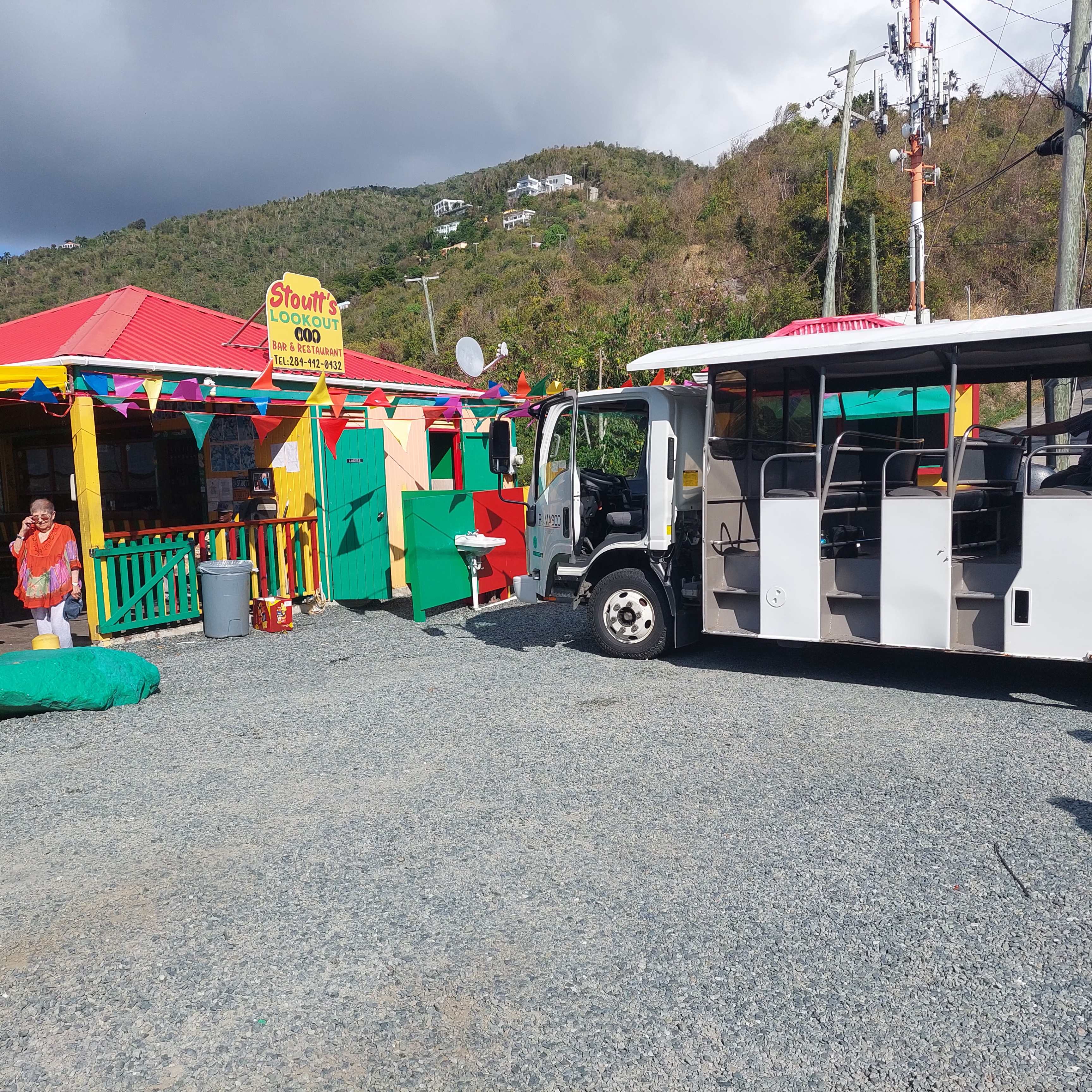
Finally we reached a high point on the shoulder of the mountain with a little pub and restaurant called Stout's Lookout, where the driver at last stopped. Here we could get out of the vehicle, take pictures of the blue Atlantic on both side of the mountain's shoulder, and enjoy a beer and a snack. Then we resumed our journey across the mountain. We passed a convoy of some 10 jeeps going the opposite way with what we assumed were Amercian tourists. Finally, he passed another ridge and he stopped for us to take a picture of the more turquise coloured Caribbean Sea on the other side of the island, with Road Town visible with the two cruise ships down in the quay. As we descended from the mountain, breaks screeching, in another steep drive along a zig zaggy route, we passed more and more houses, mostly a sign of prosperity. This was marred by the fact that every third or fourth house was damaged and empty, which I put down to the effects of the unrepaired hurricane damage from six years ago. By the time we reached Road Town the ratio of prosperous housing decidedly improved, presumably from some UK based post-hurricane community investment. Certainly the tourist areas clustered around the pier appeared neat and spotless.

By 5pm we were back on the quay. We walked through the harbour entrance building with its souvenir shops and sad huddled passengers standing against the side of the corridor and linked to their loved ones. We rejoined the ship and waited for dinner, as I started my blog entry for today.  The vessel sailed at 6pm. 

While chatting with other passengers I heard that one who was on a later bus to our tour refused to continue risking his life with that driver after they had reached Stout's Lookout. Consequently the bus left without him. The ship had to book a taxi to collect him from there. Wonder who paid for that?  

Our quiz did not go too well that night (only 6 right out of 15) as we swapped stories about our various excursion experiences. I noticed that they had that ridiculous silent disco game again in the Observatory, where people dance to different styles of music that they hear on their earphones. I gave that a miss and got ready for bed.

Across the Caribbean


Borealis Monday 1st May 2023

Somehow, sometime in the night the air conditioning must have been restored. No announcement was made, but suddenly it began to cool down sufficiently for us to automatically drag a sheet over ourselves. When I woke at 5am I was both cold and clammy and struggled to take off my pyjama top which was wet through, and to replace it with a light t-shirt. The door to the cabin was closed now, presumably by Albina. When I stepped outside I was enveloped by a gentle warmth.

I went back to bed and 9am was ready for a good hearty breakfast. Albina stayed back and I brought her some watermelon slices. We were sailing across a smooth sea, and the only thing plaguing us now were the flies that had come onto the vessel in Santa Marta, another victim of the rainstorm. Our daily broadsheet, Daily News, was very useful for swatting flies. I had noticed streaks of orange vegetation sweeping past the vessel at regular intervals which seemed a bit of a mystery. Otherwise no sign of life on the sea, not even seabirds. Again we are alone at sea, without a ship in sight, just as we were in the Indian Ocean and the Pacific. It is making how large the seas are in this world. It must have been very unnerving commanding the Spanish galleons across these seas knowinh that English and French pirates were ready to leap upon them across any of the Windward Islands facing them. 

At 11am I went to a lecture on the royal regalia in preparation for the Coronation. Very well prepared lecture with a slide show of coronations from Edward the Confessor to Elizabeth II to the soaring music of Handel's Zadok the priest. As an apology for the problems with the air conditioning the captain offered all of us a rum based cocktail at the poolside bar. In the early afternoon we had a session of meeting the captain, Victor Stoica, a Romanian, along with the new hotel manager. Both of them answered questions about the boat and about themselves. For instance, they discussed their cooperation with pilots at the various ports and more personal questions such as what they did in their cabins in their free time (rephrased by Sammee as, what were their hobbies?). I asked about the streaks of orange vegetation. Captain Stoica assured that this was not pollution by the vessel, but clumps of vegetation which found its way to the sea following yesterday's storm, which are simply being rechurned by the vessel. Another asked about predictions for weather in the Atlantic, to which Captain Stoica sounded quite optimistic. Then a curious question from a frail old gentleman who could hardly stand up. "As this is no longer an American ship, but a British ship, why are the restaurant staff still greeting us with American phrases, such a how are you." Of course the vessel was never American, but Dutch, when it part of the Holland-America Line. However, leaving that aside, this question raised an angry outcry from other listeners, and Sammee hastily reinterpreted the question as "Why do so many of the staff, especially the East Asian ones, have American accents." She explained how many of the catering staff, in particular, would have been educated and trained in schools using American English, and that what was important was that the staff be polite and friendly. to which everyone applauded. I felt sorry for the old gentleman, as I know where he is coming from. When I first came I was embarassed, even offended, by the sheer obsequiousness of many of the satt in both restaurants. Most English tourists find that embarassing, but perhaps it is required for American passengers. With time most of the staff get to know us, and we get to know them, often by name, and they can allow themselves a little cheekiness to make their job more fun. No problem with that.

I had arranged with Tony to meet at 7pm to follow up on his offer to let me make use of his professional photos from the tour for my book. We met in the Library by the map rack. Tony laid out our his folder for literary thousands of brilliant professional pictures of the cruise so far. Ever the professional, his pictures showed the master photogapher at work as each photo was a composition with an emotional touch. The emotions vary of course, as they include humour, pathos, simple joy, and occasionlly something more sombre, especially with pictures that show poverty and pollution. Yet, despite his professionalism, he has generously offered to let me use as many photos as I can choose to illustrate my blog, and any publication that could arise from it. He promised it earlier in the cruise and now he has been as good as his word. We got down to the selection. After two hours we had only gone through his pictures from Lisbon to Tokyo. I took a raincheck for those covering Honolulu to St Kitts and Nevis. We will probably look at them again on Thursday. But I am eternally grateful to Tony for his generosity.

I attended a concert in the Neptune Theatre by the Borealis String Trio. I had watched them make their often lonely performances in the Ocean Bar and elesewhere, and I am glad that they have been given a proper venue to show off their talent. It was enchanting to listen to their version of "Out of Africa", a beautiful peace of music which reminds me of the Kenyan savannah and the Great Rift Valley, with giraffes gliding across the horizon, and millions of wildebeest and zebras trekking  for miles from the Serengeti to the Masai Mara. They also played an Elgar piece followed by a chardash, half decadent, half violent. I enjoyed the performance and enjoyed they were able to appear. 

We had an anarchic quiz night. It was advertised in The Daily Times as a Reverse General Quiz. What did it mean? Annie, one of the staff, explained the rules. She will be giving an answer first and then we had to write down what the question should be to which this was an answer. Example: Answer, London. The question was What is the capital of the United Kingdom. We had to think outside the box, with inverse logic, but finding the simplest, not the most completed answer. So we muddled thtough. Some questions were easily. Some stumped us. What is Nuuk, for instance? The capital of Greenland, apparently. When we got through to the end she asked us what our groups had scored. The lowest team gotonly 8 answers right. So Annie declared them the winners. As we heard this in stunned silence, she said, "Well, I told you, this is a quiz in reverse." We left the room, stratching our heads. 

I went for a quick dance in the Observatory on Deck 9, and then I slipped over for a late supper of a couple of fajitas. After all, I had missed dinner slouching over Tony's photo. I also brought down a couple of chicken drumsticks and a coffee for Albina. In bed by 2am. 


Saturday, 29 April 2023

Tayrona National Park


Borealis Sunday 30th April 2023

At 8am we arrived at Santa Maria, still in Colombia. Compared with the flamboynce of Cartagena, the port looked shabby, though there were still some high rises in the distance. The port looked all the less attractive because of the storage of export coal, and the silos full of maize. Santa Marta is the oldest Spanish settlement on the Amercian mainland. It is also reputed to have a pretty town centre. However, most of the passengers had booked excursions to take them away out of Santa Marta, to a coffee farm, to the historic indigenous Taironaka settlement or (as in the case of Albina and me) to the Tayrona National Park. 

Initially as our coach eked its way through narrow road adjoiing the wtown centre, I noticed some spectacular and soulful graffiti in vibrant colours on the street walls. They seemed to show aspects of local life and birds and were presumably the result of a community project, rather than the work of individuals. One of the murals appeared to be almost 100 metres long as iy contined along the entire length of one block and seemed to be a narrative of some sort. All this I glimpsed as our coach shot past. But that did not prevent me from noticing the poo state of yhe pavements alongside these splendid murals. The responsible administration was obviously failing the community even when the community had made its own remarable contrubution to the appearance of the city. 

As we travelled there I noticed that the area was poor, the quality of the roads and of the suburban and rural houses, and rubbish lay everywhere, probably not collected for weeks. We crossed over a seemingly complete railway track along which people were walking, as if on a road, including a father with a small child. In the meantime our coach reflected that poverty, with seats that were not upright, safety belts that did not work and a microphone system that did not work either. The two guides, alternating between themselves, talked to us from two ends of the coach. They spent a lot of time talking about the lore and customs of the Indian population.  We learned about why they all chewed coca leaves as a substance that sustained their strength and their well-being, and how an attempt to link it with cocaine production by earlier authorities had contributed to the earlier partisan war by the peasants against the government. The election of a left wing president in the last year had led to a reduction in tension, as the promises from the earlier ceasefire agreement was slowly being implemented. One of the guides went into a long explanation of how the indian population in the Tayrona Park lived in different tribes, wearing different hats, participating in different economic activities, at different levels of altitude. However, they all carried their paporo produced from a pumpkin and filled with sea shell dust, which was presented to them on reaching a responsible age, mostly at 13 years old. From the state of this paporo, which they have to carry, their elders could tell if they have led good lives, and would punish them with incarceration or slave work, if they did not. To me it sounded like mini Chinese Communist Party levels of control, with less sophisticated, but equally effective, methods of social control and conformity. We were being bombarded with constant new strange names for different aspects of this Indian customs and culture, which struck me as increasingly primitive and irrelrevant to our needs in visiting the Park, but at least we learned that education at school and university level was now more accessible with the new government. Did the pupils take their paporo into class? Sometimes these paporos would be manufactured in pink gold, an alloy of local gold and copper, with beautiful ornaments. Many of these were plunderd from unmarked graves in the hillsides of the Tayrona Park. This practice has now become illegal and there is an attempt to have some of these paporos restored to Colombia from foreign museums.  

We were travelling now on a good quality road, which was part of the Pan-American Highway, until we turned off onto a glorified dirt track which happened to be the park entrance. The Tayrona National Park is now owned by 4 out of the 120 Indian nations living in Colombia. It is a vast area containing most of the Sierra Nevada de Santa Marta, a mountain range with 3 peaks at 5700 metres (Colon, La Reina, Bolivar), which are separate from the Andes. They contain a massive amount of plants and trees, wildlife in the form of caymans, jaguars, monkeys and lizards, insects, not to mention 2000 different species of birds, as well as the site of an ancient indigenous city.  

Eventually, we disembarked for a walk across very rough terrain and our two guides split us into two groups and led us through the forest. We were shown a wide range of flora, including mango and banana trees, and the pumpkin tree from which they produced their precious paporos. We came across armies of green ants marching with single-minded concentration along straight highways, carrying all sorts of leaves heavier than themselves. You needed to step across their half hidden path without disturbing them. "Reminds me of the Ho Chi Minh Trail," I joked with Ranald, who was also on our coach party with Sharon. There was a big ball hanging from one of the trees, which turned out to be a termite nest. Unlike their castle building cousins in Africa, these prefer to work from the safety of a tree. 


We trudged in the 33 degree heat past huts and even a restaurant prepared for rich visitors "roughing" it overnight in the forest, until we came out on to a beach. There was a strong surf, white sand and even a little bar with drinks, as well as shaded tables, where we stopped for a few minutes. The beach brought us no joy, because we had not been warned that we would be trudging through soft sand under a hot sun, and none of us had been advised to wear beach wear. Albina was exhausted by now and I needed to help her as we trudged back to the coach after our two hour trek. We saw one shy monkey and a couple of lizards, but had seen no other animal. We did see one of those native chieftans or Mamos in their full traditional dress, sitting at a table. I asked the guide if I could photograph him, but the Mamo signalled a "no". He was too busy, but with his mobile phone, not his poporo. 

We were then told we were travelling back to the ship. We had had no opportunity, as we walked through the dense undergrowth, and then the open beach, to take any pictures of the mountains which were such a central feature of the Tayrona National Park. Also there was no stop for buying souvenirs at the entrance, including examples of their much heralded pink gold ornaments. What with the rickety coach, the guides rattling on without microphones about strange aspects of Indian life, the heat and the unexpected beach, I found this possibly the worst excursion so far, even worse than the stopless coach trip in Nagoya. Others tended to agree with me. 

It was my intention at the end of the tour, to have a quick lunch on the boat, and then slip out for a quick half hour or so to the town centre of Santa Marta, to take a few photos. The town centre was apparently just a 20 minute walk from the ship and a taxi rade would have cost around 3 dollars. During our journey out we had been driven straight out of the port onto the rubbish strewn suburbs, missing out both the Spanish town centre and the more prosperous residential areas. After all, the small but picturesque cathedral I had seen on photographs was the oldest Catholic church in the Amercan mainland and worth a visit, however fleeting. Also Albina's Polish friend Marta had actually asked us to send her some pictures of the town centre, as she had always been fascinated by this remote Soth American town which bore her name. There would just have been enough time for that, as it was now about 2.15pm as we approached the dock, and the boat was due to sail at 4pm, Unfortunately, as we neared the dock, we were subjected to a sudden rain storm accompanied by thunder and lightning. We watched as the side streets were suddenly engulfed in torrents of water pouring along the high pavements, and where no pavements existed, along the formerly dusty road surfaces, carrying all the rubbish forward. The rain eased just enough for us to jump from the coach onto the ship's gangway, but then resumed its intensity. It made my planned outing to the Santa Marta town centre impossible. It was very frustrating, particularly as the ship's stay was extended because one of the returning coaches from another excursion got waterlogged from the rain. Ironically, as we waited for this coach to return, the weather suddenly improved, the clouds parted and I could normally have made the journey.

As we waited for the ship to depart we became aware that the air conditining on the ship was no longer working. The captain made an announcement about his engineers working on the problem. He repeated this apologetic explanation two more times during the course of the evening. It became warmer inside the ship inside than outside. All that heat from the Colombian jungle now seemed trapped with us inside. We were all getting sweaty and uncomfortable. Even at the evening quiz, we sat perspiring. Albina had earlier opened wide our cabin door, but our friends in the lower cabin were unable to do that. We joked about them all piling into our cabin for a party.

By midnight Albina and I had changed into our pyjamas and lay on our bed with all the sheets off, trying to sleep. I just remembered at the last moment to move our two watches an hour forward.

Friday, 28 April 2023

Cartagena de Indios


 Borealis Saturday 29.04.2023

A strange dream in the night. I was on my way to work and caught a bus with some other commuters, mostly young men, at a bus stop. The bus was taking us on a different, more rural route, as we all talked and chatted to the middle aged lady who had greeted us as we entered the bus. We were all in excellent spirits happy with the thought that we would arrive at work a little later than usual. I was looking at a map to explain the route to another passenger, and it seemed familar, but in an imprecise sort of way. And then I suddenly felt a note of alarm. I did not recognize the English countryside around us. "Where exactly are we?" I asked the lady. The others stopped talking and waited for her answer. I can't remember what she replied, but she implied we were on a journey to nowhere in particular, like a joy ride, more than a planned mystery tour. Then I woke up.

I am obviously on a countdown to reality, The dreaminess behind this cruise is close to ending. We have drifted here divorced from the humdrum life at home. For Albina and me that is a dream lasting 80 days and never to be repeated. Our financial reserves could not permit something like this again. But for others on this voyage the dream is reality. They have no reason to return as their children have flown their nest. Others want to be with friends and relatives at home to tell them of their adventures, before they again plunge into this world of cruising where they are being pampered and spending money they have earned in their hard working earlier life. It is a fantasy life withour much purpose for people with higher octane finances.


Next on our current dream tour is the port of Cartagena de Indios on the coast of Colombia. We are scheduled to arrive before noon today. The sky is overcast and the sea is calm.  Initially I sunned myself by the pool and then moved over to our cabib balcony. Albina remained in bed with the fruit I brought her for breakfast still untouched. I watched the coast sitting and drowsing from our balcony, surprised that it was on the port side. That suggests that the boat sailed in a circle padding Catragena so as to approach it from the east. I watched the low level coast pass by waiting for the first sign of a city on the horizon. To my surprise the coast suddenly started disappearing. I was amazed as I seemed to be staring at a deep inlet or even an open sea. I stood up to peer to my right and was completely stunned by the sight of a forest of high rises only a mile away. They reminded me of a group of meerkats standed to attention carefully watching the horizon. This group of high rises is matched by a further smaller batch of high rises several miles to the west which form the backdrop to 6 high cranes and two empty piers, one of which is designated for us. The port is covered by a mass od containers from all over the world, stacked six high like lego boxes. The sunny weather had begun to cloud over again and there was a speck of rain in the air as we drew into port. The pier looked surprisingly empty with one longshoreman waiting for us, and we all joked that perhaps they had got the date wrong and were expecting us tomorrow, However, just as we were within touching distance of the pier, two more appeared from nowhere and caught our mooring ropes.  The time was 12.15 and we would be here until 10pm.


Albina had got up by now and we had lunch. We had at least four hours before we had to leave on our tour. We decided to visit the Oasis Park connected to the Port Terminal. As we left the ship we were faced with pouring rain. A shuttle bus had been provided by the port authority and that drove us the short distance before we reached Oasis Park. It was not a large enclosure, but so enchanting in content. It consisted of a large souvenir shop selling goods, ranging from jewellery, handicrafts to clothes, which was surrounded by a mini zoo of local animals. The first large enclosure with an imaginative lake and stream, included flamingos, black swans and brown pelicans. However the park also included pecocks and parroys of all colour, which seem free to leave and wander around the nearest buildings but also come back to be fed. I had never seen so many parrots, blue, red and green. There must have been near enough one hundred. 


Other animals included toucans, anteaters, turtles, tortoises and sloths, Albina's favourite. When in a Costa Rica gift shop she had bought herself a cuddly sloth, which she keeps next to her when she sleeps. Here she went all mushy when she saw a keeper hold a bay sloth, almost as endearing, if not as handsome, as a koala. She stroked it and posed with it and of course I had to take a picture of that. In the gift shop she bought herself a gold chain and a beautful leather brief case adaptable as a laptop case. Altogether a very enjoyable visit. As the rain had stopped now we caught the shuttle bus again tore turn to the ship. 

Our tour started just before 5. A coach carried us to the city centre. As we passed through the area surrounding the port we were dismayed to see how many houses were surrounded by high walls topped with barbed wire. Cartagena has a population of 1.5 million and is proud of its multiethnic mix, but obviously there are still social tensions in the city, which is the fifth largest in Colombia. It has to be remembered that Colombia could be a violent place. There were decades' long struggles with drug cartels, based particularly in the cities of Medellin and Cali, and there had been a guerilla war with the native populations in the countryside for decades as well. It is not surprising therefore that even now, with a left wing president, there are still the remnants of these tensions, with disaffected former guerilla still trying toadjust to a peace time economy.  


After a half hour's drive we reached the Castle of San Felipe de Barajas, one of the largest fortress I have ever seen, comparable to the ones I saw in Cairo and Agra, but more concentrated in its sheer mass. Its construction apparently started in 1536, but the most doinant section of the fortress was added in the early seventreenth century after the destructive attacks by Francis Drake, and to prevent further attacks by buccaneers and British and Dutch privateers. Cartagena Castle was important because it was the Fort Knox of the Spanish Americas. All the gold and silver and precious stones collected from Acapulco in the north to Cuzco in the south was accumulated in Cartagena and then shipped from there to Spain. This made Cartagens a tempting city to attack, and explains why not nly the fortress was built, but also a massive wall surrounding most of the city, of which some 13 kilometres still apparently remain. Both the fortress itself, and the remaining ramparts surrounding the city contributed not just to the safety of the town in the past, but also to its prosperity as a tourist attraction in the present.


Within these wall is a charming street layout still reflecting the splendid Spanish houses in shady streets belonging to those conquestadores, colonial officials and merchants who had become rich as a result of plunder, trade and the sale of slaves. Apparently, a total of one million slaves were sold in the markets of this city over two centuries. 


The next stage of the excursion was to travel around this wonderful old town centre in hors-drawn carriages. Albina and I shared a carriage with Lisa and Steve. It was a wnderful way to sample the colours and smells of the old colonial quarter in the darkening dusk. We must have driven around for at least 45 minutes watching and being watched by local traders, residents and tourists, as passed under the decorated wooden balconies and house fronts painted in yellow, red and green. The locals could be boisterous. As the cavalcade of horse carriages paused at one point, some sprightly young local Colombian rappers began a five minute chant literally leaning in to our carriege. I brushed them off with a two dollar bill for their trouble. We also passed churches, museums, hotels, jewellers and expensive fashion stores. We could also see the roof and high dome of the Cathedral a block away from our carriage tour.  By the time the carriage ride finished it was dark. We were able to do some more shopping for gifts and souvenirs in the Las Bovedas, the former dungeons, and now a popular arched arcade of shops attached to the city walls. Then the coach took us home afer what we considered a more than satisfactory tour. But again, we were alarmed to see how poorly the city streets were lighted. It is a mater of what you are used to, but, outside of the Old Town,  I would not choose to wander around the streets of Cartagena at night.

A lovely Colombian experience awaited us on the ship. The vessel had booked a local Colombian Folkloric Show. It was a troupe of six young male and six female dancers  from Colombia with a sensual and energetic display of traditional Colombian dances. I say traditional Colombian, but actually the tradition is overwhelmingly African. Apart from the Fandango and the dance about a farmers market, which are both Spanish Amercian, the remaining dances all told stories, of  peasant or fisherman's life, or about the jealousy of two women over one man, and were danced almost savagely to the beat of African drums, accompanied by an indigenous flute. The women and the men dance wildly waving their arms without grace, and then the women were lifted in turn either individually or together in a mutual cradle hold, and then tossed and spun round crazily to an ever increasing beat. All the time they wore flamboyant Spanish style costumes, which again mixed the genres and made the whole performance extraordinary erotic. It was a wonderful breathtaking performance.

Helen and Tony did not turn up for the late night quiz, but the remaining three battled on to get only 11 out of 15. 

Thursday, 27 April 2023

Panama Canal


 Borealis Friday 28.04.2023

By the time I had woken in the morning we were in the Panama Canal, and at 7.45 we were at our first lock, the Miraflores Lock. We had already got under the first bridge over the canal before we got this far. From my balcony I could see somewhat unedifying scrubland reaching up to the level of my deck. There was a massive vessel higher up ahead of us waiting to enter the neighbouring lock, after our vessel had gone through. The water level beyond the gate reached up to roughly our promenade deck but by that time we had spent 15 minutes in the lock so it had probably been a little higher. The Miraflores Gate House building is less than a stone's throw away from my cabin balcony. An Olympic long jumper could easily have covered it. A young female operator had stepped out onto the balcony as we passed it at the same level as me, and we greeted each other in Spanish. When I stepped out onto the Observation Platform on my deck I could see the starboard side as well. There there was a car park there and a road passing through into the forest beyond. Looking back on that side I could see several high rises in the distance which were part of Panama City, and the destination of the first bridge across the Canal.

Earlier when we had reached Panama Bay, we had veered north to enter the 44 mile long canal. We had finally left the Pacific Ocean after 28 days. The canal territory is policed by the U.S. armed forces and most of the land around us is administered by them. Once we were lifted higher by the lock, we found that another vessel, a container vessel, the Malaysian MSC Scia, was parallel with us on another lock, that we had not spotted until now. It was proceeding northwards to the Atlantic. After 50 minutes we appear to have finally cleared the first lock. We then moved into the second lock, te Pedro Miguel lock, which we had cleard by 10am. In the meantime I had had my breakfast, took Albina her Sugar Frosted Flakes and popped out on the observation platform again to catch a picture of the next large bridge spanning the canal. This was the six lane Centennial Bridge. Bolearis proceeded up the canal, seeming, like Alice, to be chasing the elusive container vessel which appeared like the White Rabbit to be escaping around the corners in the twists and turns of the canal route.


The sides of the canal had initially consisted of high stratified banks of earth piled up from the original earth dug up in the construction of the canal in the 1910s. This section was called the Galliard Cut. They were at least two deck storeys higher than the Borealis. We passed a Chinese COSCO container vessel followed by an Australian vessel called Spirit of Sydney, on their way to the Pacific. The widened sides of the canal now turned into jungle, and included breaks for shady inlets among the mangrove swamps, where some crocodiles were sighted (but not by me). We were still following the Malaysian vessel when a great white passenger vessel hove into view. It was the Royal Caribbean cruiser, Radiance of the Seas. As we passed each other in the narrow channel, we waved, and some witty bugger shouted to them “You’re going the wrong way!”. And then the official greetings started, initially as blasts from both ships’ sirens, and then as a concoction of strange sounds, with a wide range of tonality, which seemed to resemble the vocal rhapsody at the end of Close Encounters of the Third Kind. This strange sound reverberated over the still waters of the canal and the surrounding jungle canopy. After that we emerged into the lakes and followed a path across them laid out by buoys and metal markings.

Albina considered this a good time to get the laundry done and then to leave a bag of shirts and trousers in the corridor to be pressed. At least she avoided long term ironing that way.  All that took about an hour and a half, but I carried on chatting on the observation deck to my Polish friend from Southall, who runs a commercial roofing business in Ealing from his cabin, while his wife runs the accounts. He was enjoying the tour so much he decided to book another tour around Australia, the South Pacific and South America next year, but he books most of his excursions by internet with local agencies at each port. I am sure he saves money that way, but my wife would prefer the security of the more expensive Fred Olsen excursions. 

The construction of the Panama Canal was an amazing achievement, but during its construction under French administration nearly 20,000 died from tropical diseases. The French gave up, but the Amercans took over the project and finished it in 1913, although at least another 5,000 perished. About 40 large vessels now use the Canal each day. The lakes we were crossing now stretched out in all directions as we remained surrounded by virgin forests. Finally, by 2.20pm we had completed the crossing of the lakes and arrived at the third lock, the Gatun Lock, having allowed the Malaysian ship to slip in before us. this lock was to drop us down to the level of the Atlantic. As we were being dragged into position by four small engines on train tracks acting as tugs, two on each side, we sided up against a Texan tanker, being dragged in a similar way on the other side. At 3.30pm we had cleared the locks and could feel the gentle swell of the Atlantic, even though we were still in the canal and approaching the last bridge over the canal. In the meantime, a smaller Ecuadorian cargo ship slip in behind the Texan tanker that was going the other way.

The last bridge over the canal is the newest. The Atlantic Bridge, a vast four lane suspension bridge between two towers, seemingly built of white concrete, links western and northern Panama with the industrial port of Colon on the southern side. The bridge appeared to carry only about 5 cars in the 15 minutes or so of our apprach to the bridge, but again it may not have been the busiest time of the day. Its two approach roads seemed to disappear somewhere in the jungles on either side. However, the canal immediately widens into a sea outlet as soon as we pass it. The city of Colon appears on the right, with about twenty massive port cranes being the most noteworthy feature. As we appraoched more closely, we could see that about 5 large wharves, surrounded with some of the cranes, appeared to face the canal, the other cranes some two miles away from the first, appeared to face out onto the Atlantic. It looks like a clear distinction between canal traffic, possibly with goods still under clearance, and Atlantic traffic importing directly into Colon town. It was only after we had come level with Colon that I noticed two massive breakwaters, one coming out of Colon, and a matching one from the other side possibly some four or five miles long from northern Panama. The gap between these long and thin breakwaters was about the width of two vessels like Borealis. Perhaps they were a warning to Atlantic traffic that they are now entering Panama Canal waters, which are, after all, a U.S. militarized zone.

Once through that barrier and we are out in the Limon Bay, which is part of Atlantic proper. It is now downill all the way to Southampton. 15 days to go. England get ready.

I see that my colleagues in the Federation of Poles have heeded my comments in my letter to Mr Mularczyk. Two members of the executive came to the meeting as a record of thier interest, but contributed nothing. Probably the wisest course to take until this stupid campaign blows over, but unfortunately some prominent UK Poles, like Marek Laskiewicz, POSK Chairman, will probably get drawn up in this act of folly. 

 Also we had good news about my friend Zbyszek, He is now out of his coma, sitting up in bed and asking his wife for his mobile phone and cable. That is promising. 5 days ago we was at death's door.

The Borealis Theatre Company surpassed themselves with their Carnival of the World show. The choreography, the costumes, their lighting are so superb and had everyone on their feat with support. The five vocalists and three dancers who form the group are able to put on a lively new show nearly every week. When do they rehearse? How come each performance is faultless? Here they chose popular and some time classical songs from around the world and had costumes to match and into which they managed to change six or seven times during a 45 minute show. This Theatre Company is one of best of many briliant features of this Fred Olsen cruise.

By the way, even today, I have twice been congratulated by new people for my talk 3 weeks ago. It must have made an impact on those who came. Vert pleasing, but still extraordinary. Maybe because it proved together the fantasy of this voyage, and the fantasy of Jules Verne's world with reality. I don't know of any other talk that seemed to stay in people's memory so long.

Only 12 our of 15 in the quiz. The 2 winnong parties had 14. Each time we start with hope and then flounder on one or two questions which we perhaps could have risked a better informed guess. For me this quiz shows how much I have known, but since forgotten. I struggle to remember a name, but then one of my colleagues mention one, and I instatly know it's right. I mostly remember the facts that I knew from my schooldays and university. Thos remain in my brain, and that is still a good proportion of the questions we get.

Albina and I both felt a little hungry as the night wore on. After all, we had both missed high tea (which is a good thing) and dinner. However, I have only just discovered in these last days that there is a Supper Club every night between 11pm and midnight. Every night. We went up to the buffet dead on 11. The buffet was just opening. A full menu was laid out as for a normal meal, mostly consisting of cold meats, vegetables and cheeses, but with some hot meals as well, such as hot dogs with good quality sausages and onions. CLitchen staff and waiters in attendance. The latter poured out water as usual and offerred tea or cofee. Apart from us, only a handful people came in, mostly revellers in carnival dresses taking a break from the dancing and drinking in the Neptune Theatre. Nobody stayed longer than ten minutes, In all, for the twenty minutes we were there, some ten people turned up for food. An utter waste of time and money. And when do these members of the catering staff sleep? 

We watched some TV programmes and were in bed by 12.30.